Blog of Academic Director of Visionary Program- Olga Shirobokova: Developing changemaker skills is like riding a bike🚲
Developing changemaker skills is like riding a bike🚲, he said. Once you learn it, you can’t unlearn it anymore.
A person with a special place in my heart shared this metaphor. He seems to have a good intuition. And I am curious to explore his message these days.
45 years ago Bill Drayton founded the field of social entrepreneurship.
Back then he said – in human history there have always been people who address societal challenges – that neither governments, nor business can/want to deal with – and do so with courage, creativity and entrepreneurial spirit.
People who work towards making healthcare more accessible, education – connected to the individual and world’s needs, damaging environmental practices – regulated, marginalized people – having infrastructure of support, true participation and the feeling of belonging.
Systems changing social entrepreneurs.
These individuals need support, networks and resources to accelerate positive impact, he said. And this has been the focus Ashoka, the organization he founded, in 90 countries.
Interestingly, Bill has taken part in the selection of each of the 4000 social entrepreneurs ever elected as Ashoka Fellows.
And similarly to the way people train AI these days, for the last 45 years Bill has been training his own brain by looking into the most effective strategies these people employ to achieve systems change – across geographies and topics.
His main learning has been that the most impactful social entrepreneurs 𝗲𝗻𝗮𝗯𝗹𝗲 𝗼𝘁𝗵𝗲𝗿𝘀 𝘁𝗼 𝗯𝗲 𝗰𝗵𝗮𝗻𝗴𝗲𝗺𝗮𝗸𝗲𝗿𝘀.
In other words, they help people become:
👁️ attentive enough to notice problems,
💫 courageous enough not to look away from them and take initiative,
🔭 visionary enough to imagine a new reality,
🤝 team-oriented enough to invite others to co-create solutions and
🎯 persistent enough to stay on them.
And the only way solutions can outpace problems, he says, is when many more people, actually, everyone, feel they can and want to be hashtagchangemakers – for their own and universal good.
This thinking has had tangible implications. The strategy of Ashoka has shifted from supporting individual “Innovators for the public” to “𝗘𝘃𝗲𝗿𝘆𝗼𝗻𝗲 𝗮 𝗰𝗵𝗮𝗻𝗴𝗲𝗺𝗮𝗸𝗲𝗿”.
It took me a while to understand what Bill means. But this idea has truly grown on me now.
Wouldn’t a world be a better place when people of all ages, genders, geographies & sectors can and want to contribute – in roles and at levels that are feasible to them?
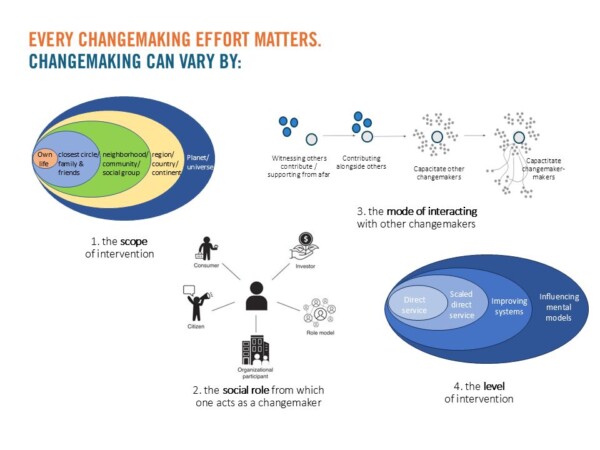
I have become more attentive now to ways people can be changemakers in different, even subtle, ways – as consumers, organizational participants, parents, at neighborhood level and many other ways.
Diversity of changemaking has been on my mind.
I tried to visualize multiple ways I imagine one can be a changemaker. And by doing so, I also realized that the levels and manifestations of changemaking can be different at different stages of our lives.
Are any of them seem relevant to you now? 🙃